For security reasons, you will be logged out in 4 minutesCannot be added!Your basket contains a blocked quote and must be finalised before you can order other items.Add to basket...Item added to basket
Express
order
Basket0

Laboratory cleaning accessories: which equipment helps control contamination?

In a laboratory, contamination control is not a detail – it is mission-critical. Brushes and bottle brushes for glassware, validation swabs to verify the absence of residues, squeegees and brooms for floors, HEPA vacuums for fine dust, buckets, soak tanks and trolleys to organise your protocol: robust tools, some autoclavable and compatible with disinfectants, engineered to meet GMP, HACCP and ISO 14644 requirements.
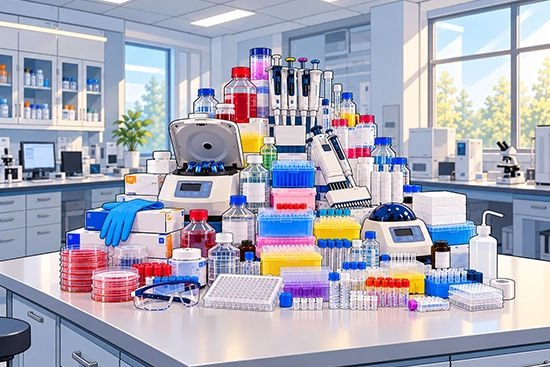
What lab cleaning supplies do you need – and how to choose them?

The right combination of accessories optimises cleaning efficiency, lowers the risk of recontamination and safeguards your results.

• Vacuum cleaners with HEPA/ULPA filtration to capture fine dust and sensitive powder particles. ATEX-rated versions available for hazardous areas, and wet/dry models for liquid pickup.
• Soak tanks and graduated buckets, in plastic or stainless steel, with or without lids. Autoclavable depending on model.
• Cleaning trolleys (double bucket, wringer, storage) to separate dirty from clean and structure the steps of the protocol.
• Brushware, bottle brushes and detail brushes in PBT/nylon or specialty fibres, one-piece moulded mounts to prevent retention, for glassware, columns and small equipment.
• Cleaning swabs (foam, polyester, microfibre) low-lint for critical areas, and sterile validation swabs, TOC/HPLC-compatible, for post-cleaning surface sampling.
• Brooms, squeegees and sponges with low leachables for floors and large areas, resistant to common disinfectants (IPA alcohol, QACs, peroxide, hypochlorite).
• Dosing pumps (peristaltic/venturi) for controlled dosing and dispensing of detergents and disinfectants.
• Shovels and antistatic/stainless accessories to safely collect powders and debris.

Key selection criteria: surface type (stainless steel, glass, polymers), environment class (dust-controlled area or not), chemical compatibility, sterilisation method (121–134 °C), ergonomics (handles, lengths), colour coding to avoid cross-contamination, and traceability requirements (lot, sterility, certificates).

In which environments are these cleaning accessories used?

• Life sciences: cleaning of chambers, biosafety cabinets and incubators; lint-free care of cell-culture surfaces.
• Pharmaceutical & biotech: GMP bio-decontamination, cleaning validation by swab sampling, control of API and disinfectant residues.
• Food & beverage: HACCP protocols, colour-coded zoning, effluent disposal and allergen management.
• Cosmetics: removal of pigments/waxes, particulate control in the cleanroom.
• Chemicals: powder recovery, solvent compatibility, ATEX safety for combustible dusts.
• Environment & QC: sampling glassware, decontamination of wet areas.
• R&D: mobile organisation with trolleys, traceability of sterile consumables.

Frequently asked questions about laboratory cleaning accessories

Which filtration level should you choose for a laboratory vacuum cleaner?
Go for HEPA H13/H14 to capture fine particulates. Where solvents/explosive dusts are present, choose an ATEX-certified model matched to your zone.

Are brushes and bottle brushes autoclavable?
Many PP/PBT designs with one-piece frames are autoclavable (121–134 °C). Check the product datasheet: some fibres or adhesives won’t tolerate it.

How can you prevent cross-contamination between areas?
Favour single-use. Use colour coding, trolleys separating dirty/clean and consumables dedicated to each room. Record usage and replace at the defined frequency.

What chemical compatibility for sponges and squeegees?
Select materials that withstand the disinfectants you use (IPA, QAC, peroxide, hypochlorite). Prefer 304 stainless steel.

What is a dosing pump used for in cleaning and disinfection?
To deliver the correct detergent/disinfectant concentration reproducibly, reducing dilution errors and improving protocol compliance.