For security reasons, you will be logged out in 4 minutesCannot be added!Your basket contains a blocked quote and must be finalised before you can order other items.Add to basket...Item added to basket
Express
order
Basket0

Bioplastics : Quels consumables PCR and qPCR ?

Bioplastics designs and manufactures consumables dedicated to PCR and qPCR: 0.1/0.2 mL tubes, strips, caps, 96/384-well microplates and sealing solutions. Engineered for reproducibility and sensitivity, its products combine thin walls for rapid heat transfer, optical clarity for real-time detection and certified cleanliness. Focused on molecular biology, R&D and quality control, the brand serves academic, clinical and industrial laboratories that demand reliable results, cycle after cycle, on most thermal cyclers on the market.
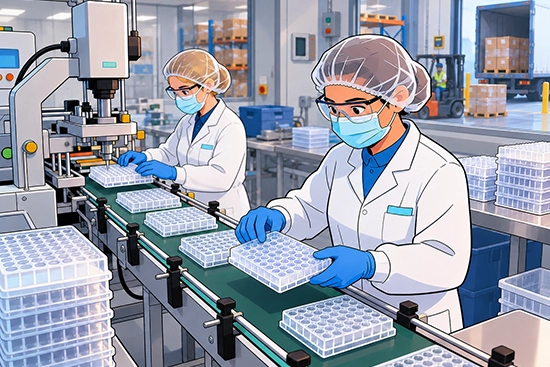
A European specialist, now a benchmark in PCR

Born from a simple idea — that amplification performance also hinges on the quality of the consumable — Bioplastics has become a leading European name in plastics for PCR and qPCR. From day one, the brand has focused its expertise on virgin polypropylene and on engineering geometries optimised for thermal cyclers. In constant dialogue with users, it keeps refining its tubes, strips and plates: uniform wall thickness, low-profile formats, white options for fluorescence, optical caps. Broadening into sealing solutions and providing lot-specific certificates have further strengthened trust. Today, Bioplastics is chosen by molecular biology, diagnostics and quality control laboratories seeking reliability, traceability and lot-to-lot consistency.

Expertise and areas of specialisation

Bioplastics focuses its expertise on critical PCR/qPCR consumables, where dimensional precision and surface chemistry govern performance. 0.1/0.2 mL tubes and 8/12-strip formats combine thin, uniform walls for fast, even heat transfer, limiting gradients and ramp times. 96- and 384-well microplates, available in standard or low-profile, in non-skirted, semi-skirted or skirted versions, meet the demands of thermal cyclers and automated workflows. For qPCR, white options maximise signal and reduce background, while clear plates remain ideal for endpoint PCR and visualisation. Flat or domed caps, optical caps and sealing films/foils ensure a secure closure, limiting evaporation and cross-contamination. The use of low-autofluorescence virgin polypropylene, tight control of surface state and cleanroom processing deliver consumables that are DNase/RNase-free and free of detectable human DNA, with lot traceability and certificates available. Bioplastics ensures thermocycler compatibility (0.1/0.2 mL, 96/384 formats) for frictionless integration with common platforms. Target applications: gene expression, genotyping, diagnostic qPCR, quality control in food, pharmaceutical and cosmetic sectors, and amplicon preparation for NGS. Day to day, the brand brings a tangible gain: higher sensitivity, lower variability, and repeatability that safeguards your runs, from exploratory assays to high-throughput campaigns.

Bioplastics range distributed by Dutscher

Bioplastics – Frequently Asked Questions (FAQs)

Where are Bioplastics consumables manufactured?
Production is carried out mainly in Europe, under strict quality control with batch-level traceability to ensure consistency and reproducibility.

Are Bioplastics tubes and plates compatible with my thermocycler?
Yes. 0.1/0.2 mL formats and 96/384-well plates are designed to fit most thermocyclers. Please consult the technical datasheets to select the appropriate plate profile/skirt style.

What cleanliness assurances do they provide?
The consumables are manufactured to be free from DNase/RNase and detectable human DNA. Certificates of Conformity and batch certificates are available on request.

White or clear plates: which should I choose?
White plates optimise qPCR by boosting signal and reducing background. Clear plates are suitable for end-point PCR and visual readout.

Are sterile options and sealing solutions available?
Yes. Bioplastics offers sterile and non-sterile variants, plus caps, sealing films and foils to minimise evaporation and cross-contamination.